Helping people understand the connections between our water, our environment, our health, our infrastructure, and our communities—and then bringing the right people together to create solutions.
FILLING IN THE INFORMATION GAP!
WELCOME!
Suzee Bailey
Founder/CEO
Residents for Resilience

"It's hard to care about what you don't know about."
Residents for Resilience (R4R) was born from a personal experience, but it quickly became about something much bigger. It became a journey to understand how some of South Florida's most important environmental challenges are interconnected—and how connecting people, science, information, and solutions can help build healthier waterways, stronger communities, and a more resilient future.
Like many South Florida residents, I found myself asking questions that seemed like they should have simple answers.
-
Is my drinking water safe?
-
Is it safe to enjoy our waterways?
-
Will my neighborhood flood again?
-
How can we better protect our coastlines while restoring the health of our waterways and marine ecosystems?
But perhaps the most important questions of all were these:
How do residents know when it's safe to enjoy our waterways? Where do they find clear, timely, and easy-to-understand public health and environmental information? And how do today's decisions affect the future resilience of our communities?
Those questions became deeply personal after I contracted a MRSA infection following a paddleboarding outing several weeks after more than 200 million gallons of wastewater had spilled into Fort Lauderdale's waterways, parks, neighborhoods, and streets. Although no one could say with absolute certainty where the infection originated, my doctors believed it was likely the result of exposure to contaminated water.
That experience changed my life.
With a background in broadcast journalism, I assumed finding reliable information would be straightforward. Instead, I discovered a significant information gap. Water quality information was often difficult to locate, challenging for the public to understand, and, in many cases, outdated. Public health advisories and safety information were not always easy to find, leaving many residents with more questions than answers.
Determined to help fill that information gap, I began researching these issues more deeply, and realized my story wasn't unique. Residents throughout our community were asking many of the same questions about drinking water, water quality, flooding, stormwater management, coastal resilience, and the health of our waterways and marine ecosystems. I also heard from people who shared stories of serious illnesses after working or recreating in local waterways. While every situation was different, one thing became increasingly clear: residents were struggling to find the clear, timely, and easy-to-understand information they needed to make informed decisions for themselves and their families.
The deeper I looked, the more I realized these weren't separate issues.
Everything is connected!
The choices we make, the infrastructure we build, and the way we manage our water all influence one another. What happens upstream can affect everything downstream. What we do on land impacts our waterways, our drinking water, our marine ecosystems, and ultimately the resilience of our communities. That's why Residents for Resilience is committed to helping people understand not just individual issues, but the connections between them. Because when we understand the connections, we begin to see the solutions.
Since it's hard to care about what you don't know about, that realization became the foundation for Residents for Resilience - because there are some critical issues we do need to be concerned about. R4R strives to close the information gap by connecting residents with trusted experts, scientific research, educators, environmental organizations, businesses, universities, and government leaders. Together, we translate complex environmental information into practical, easy-to-understand knowledge while fostering collaboration that turns innovative ideas into real-world solutions.
Today, our work focuses on four critical water issues that affect the health, safety, environment, and quality of life of every South Florida resident:
💧 Safe, Clean Drinking Water
Protecting one of our most essential natural resources through education, awareness, collaboration, and science-based solutions.
🌊 Flood Mitigation & Stormwater Management
Promoting innovative, nature-based, and engineered solutions that reduce flooding while improving water quality and strengthening community resilience.
🌴 Storm Resilience & Coastal Protection
Helping communities prepare for stronger storms, sea level rise, and the changing environmental challenges facing South Florida while protecting our coastlines and neighborhoods.
🐚 Waterway & Marine Ecosystem Restoration
Supporting education, research, collaboration, and innovative restoration projects that improve the health and quality of our priceless waterways - helping to protect the marine - ecosystems that helps sustain our environment, economy, and quality of life.
While each of these issues is important on its own, our mission isn't simply to educate residents about them individually, it's to help people understand how they are connected, why those connections matter, and how, by connecting people, science, and information, we can better identify environmental challenges, understand their root causes, and work collaboratively to develop innovative, practical, science-informed, and nature-based solutions that transform awareness into action and build a healthier, more resilient South Florida.
Because informed and connected communities -
build a stronger and more resilient South Florida!
TO RECEIVE OUR FREE NEWSLETTERS
AND INVITES TO SPECIAL RESILIENCY MEETINGS AND EVENTS!
Stay Connected - Be Part of the Solution!
Follow Residents for Resilience on Facebook, X, Nextdoor, and LinkedIn for the latest news,
educational resources, community events, volunteer opportunities, and updates on the
important water issues affecting South Florida.
Every like, share, volunteer, partnership, and donation helps us continue educating, connecting,
and empowering our communities while advancing practical, science-informed solutions
for healthier waterways and a more resilient future.
Residents for Resilience is a community-driven 501c3 nonprofit,
and we couldn't do this important work without the support of people like you.
Thank you for helping us close the information gap—one conversation, one partnership, and one community at a time.
💙 Together, we're building healthier waterways, stronger communities, and a more resilient future.
We can't do what we do with out your support!
"IT’S HARD TO CARE ABOUT WHAT YOU DON’T KNOW ABOUT!"
"It's also hard to solve problems when we don't
understand how they're connected."
THANK YOU!!!
The heat index was high.
Fortunately, the afternoon storms never arrived.
But our community did.
A heartfelt thank you to everyone who joined us for Waterlogged: Weathering the Storm at Savor Cinema!
We were incredibly encouraged by the wonderful turnout and by the diverse audience of residents, community leaders, educators, planners, environmental advocates, students, government representatives, and subject matter experts who came together for an evening of learning, discussion, and collaboration focused on flood mitigation, resilience, and the future of South Florida.
The audience engagement was remarkable. From thoughtful questions and personal stories to shared concerns, ideas, and even a song from one attendee, the evening reminded us just how much our community cares about these issues and how valuable these conversations can be.
Special thanks to our partners at WLRN Public Radio and Television, including Interim CEO Tom Hudson, Catie Muñoz, Odie Redila, and James March; the Broward Section of the Florida Chapter of the American Planning Association and Marilyn Mammano; Hal Axler and the entire #SavorCinema team; our outstanding panelists Stefan Perritano, Trinity Busch, and Frank Balsamo; our Waterlogged Event Chairs Michael Schneider and Pat Roth; and R4R Board members Vice President Tricia Halliday and Patrick Ferguson, whose hard work behind the scenes helped make the evening such a success.
Together, we shared facts, information, options, and hope—and created exactly the kind of meaningful community conversation we hoped for.
Special thanks to FSU Film Student, Owen Ortiz for capturing the evening through his lens and helping us preserve so many wonderful memories from this special event.
Thanks again to all of you for helping us continue to close the information gap surrounding the critical water issues facing our community through education, communication, advocacy, and collaboration.
Stay Informed • Stay Connected • Stay Resilient


FLOOD RECOVERY GRANT APPLICATIONS
NOW OPEN!
Published on June 04, 2026
Flood Recovery Application Portal Open
The City of Fort Lauderdale’s online application portal for Community Development Block Grant Disaster Recovery (CDBG-DR) housing assistance programs is open.
These programs are designed to support residents
impacted by the April 2023 flood event and may include assistance for:
• Home rehabilitation and reconstruction
•Elevation of homes
• Reimbursement for eligible flood-related expenses
• Other recovery and mitigation activities
Residents can apply online at: Fort Lauderdale Application Intake - Smartsheet.com
Residents who need assistance with the application process
can call 954-495-4533 for support.
Additional information, updates and application resources are available on the City’s dedicated CDBG-DR webpage: https://ftlcity.info/CDBG-DR
We encourage residents impacted by the April 2023 flood event to learn more about the available programs and apply if eligible.
__________________
The City of Fort Lauderdale’s online application portal for Community Development Block Grant Disaster Recovery (CDBG-DR) housing assistance programs will open on Wednesday, May 27, 2026. These programs are designed to support residents impacted by the April 2023 flood event and
may include assistance for:
-
Home rehabilitation and reconstruction •
-
Elevation of homes •
-
Reimbursement for eligible flood-related expenses •
-
Other recovery and mitigation activities
Residents can apply online at: Fort Lauderdale Application Intake - Smartsheet.com Residents who need assistance with the application
process can call - 954-495-4533
for support.
To help residents better understand available programs, eligibility requirements and the application process, the City has also scheduled additional community educational meetings. Community Educational Meetings:
Thursday, May 28, 2026 6 p.m. Sanctuary Church –
Banquet Hall 2501 NE 30th St. Fort Lauderdale, FL 33306
Monday, June 1, 2026 6 p.m. South Side Cultural Arts Center
701 S Andrews Ave. Fort Lauderdale, FL 33316
Residents who are unable to attend in person will also be able to view recordings of the educational meetings on the City of Fort Lauderdale’s YouTube channel. Additional educational meetings are currently being planned. Information on future meetings will be shared as soon as it becomes available.
Additional information, updates and application resources are available on the City’s dedicated CDBG-DR webpage: https://ftlcity.info/CDBG-DR We encourage residents impacted by the April 2023 flood event to learn more about the available programs and apply if eligible.
Learn More - https://www.fortlauderdale.gov/Home/Components/News/News/8425/16?widgetId=41
2023 FLOOD DISASTER RELIEF FUNDS
CDBG-DR Funding Allocation -
Fort Lauderdale Flood April 2023
On December 21, 2024, the Disaster Relief Supplemental Appropriations Act, 2025 (Public Law 118-158)(‘the 2025 Appropriations Act”) made available an allocation of $88,051,000 in Community Development Block Grant -Disaster Recovery (CDBG-DR) funding to the City of Fort Lauderdale.
Action Plan
City of Fort Lauderdale has completed an Action Plan for Disaster Recovery. The Plan provides a high-level strategy for how the funding will be used to address eligible communities' long-term resiliency and mitigation needs. The Action Plan was developed with the input from County Departments and Divisions, local jurisdictions, advocacy groups and community partners, as well as citizens, to determine the remaining long-term resiliency needs and the most critical disaster mitigation needs.
R4R IN ACTION!
Flood Mitigation & Stormwater Management
Helping fill in the information gap by sharing updated flood information, innovative stormwater
management approaches, homeowner preparedness guidance, CRS rating benefits, and available
relief or grant opportunities for flood-impacted residents.
Waterlogged Events
Bringing residents together with top specialists to better understand flooding and storm preparedness,
waterways remediation efforts, storm water management , and exploring innovative resilience solutions.
Mangroves and Coastal Protection
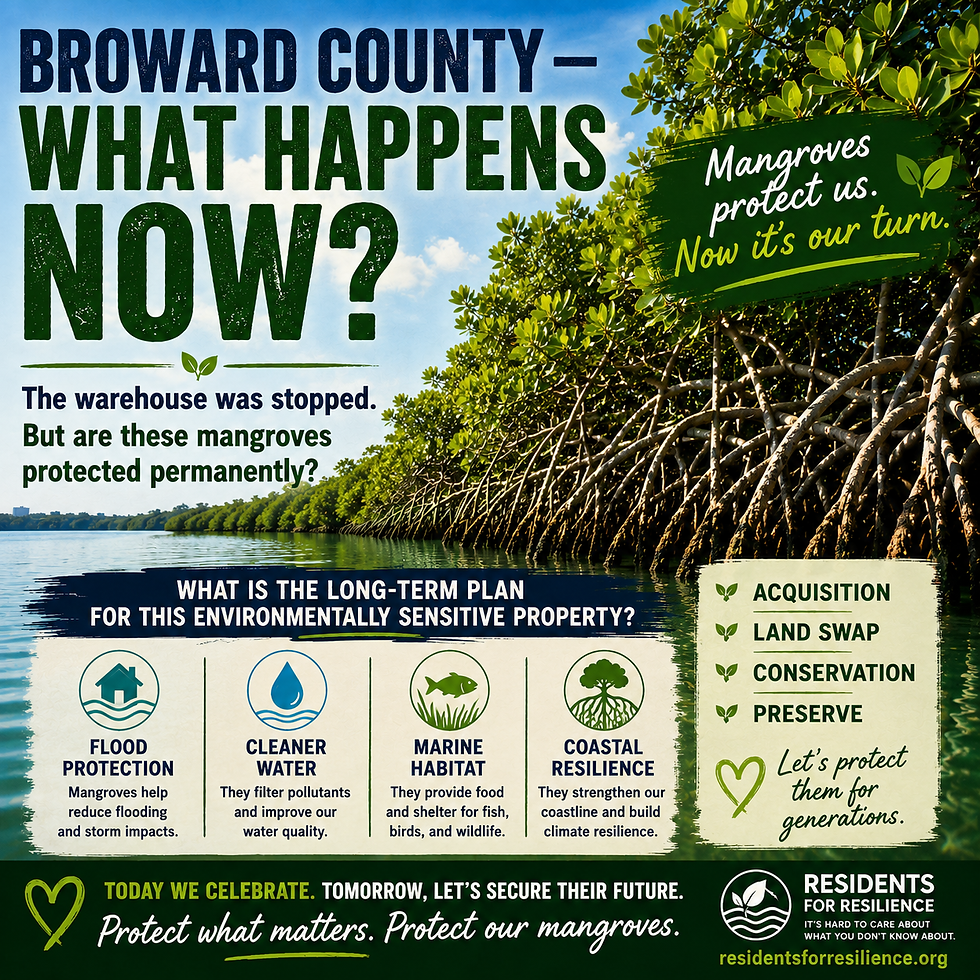
Supporting thoughtful decisions that recognize the flood protection, habitat value, and resilience benefits natural
mangrove systems provide.
Students for Resilience
Engaging and mentoring the next generation of environmental leaders through
education, innovation, and community service.
Artificial Turf & Public Health Awareness
Important questions that may need to be asked regarding the health and environmental concerns linked
to artificial turf (“plastic grass”), including excessive heat, microplastic shedding, vapor exposure, and long-term
impacts on both people and the environment.
Restaurants for Resilience
Recognizing and encouraging sustainable practices within the local business community.
Nature-Based Solutions
Promoting practical approaches such as living shorelines, mangroves, water filtration research,
biochar pilot studies and marine habitat restoration.
.
Coastal Projects & Marine Impacts
Addressing major coastal concerns including sand bypass activity, coral impacts near the port,
shoreline changes, and the broader marine and environmental questions linked to coastal construction and expansion.
Continuing Our Student Partnership
with Florida International University!
A sincere thank you to Florida International University for once again inviting Residents for Resilience (R4R) to partner through their Spring 2026 Writing About the Environment course — an exciting collaboration that continues connecting students with real-world environmental issues
shaping South Florida.
We are especially pleased to continue expanding our partnership with Dr. Marta Gierczyk, and Lucas, Luke Rodewald, and FIU’s Department of English and Community Partnerships program.
As part of this collaboration, we were invited to introduce students to the R4R mission and share our presentation on the four critical water issues that guide our work:
Safe, clean drinking water
Flood mitigation
Storm resiliency
Restoring the health of our priceless waterways
Students will now begin developing environmental storytelling projects tied to real-world environmental concerns, with R4R helping guide project development and connecting classroom
learning to meaningful community impact.
We are always encouraged by the thoughtful questions, ideas, and discussions that follow these presentations. Vice President Tricia Halliday also joined the discussion, helping contribute
to the thoughtful exchange that followed.
Our future looks brighter when students are encouraged to think critically about the environmental challenges facing South Florida and explore how communication, science, and collaboration
can help shape practical solutions.
R4R's Students for Resilience initiative continues to grow by engaging students through:
• mentorship
• project collaboration
• internships
• community engagement
• exposure to scientists, engineers, professors, and environmental professionals
These conversations matter — because informed communities are resilient communities,
and the next generation has an important role to play in shaping that future.
Thank you again to FIU for welcoming R4R into these important conversations!
Congratulations to Broward County
on another outstanding
Water Matters Day at Tree Tops Park —
A wonderful reminder of how much meaningful work is happening across our region
in support of water conservation, nature-based solutions, and long-term resilience.
A special thank you to Jennifer Jurado, Gregory Mount, and the Broward County’s resilience team for helping make this annual event such a success. It was encouraging to see so many municipalities, civic leaders, students, educators, and community partners come together around this year’s theme: “Reclaim Water, Regrow Nature.”
It was also wonderful to see Broward leaders including Commissioners Nan Rich, Beam Furr, Robert McKinzie, and Steve Geller present in support of this important event and the County’s continued focus on water conservation and nature-based resilience.
The event beautifully highlighted how green infrastructure — including rain gardens, wetlands, tree canopies, and Florida-friendly landscapes — can help mimic natural hydrology, reduce runoff, recharge groundwater, and improve water quality while strengthening community resilience.
It was especially meaningful to thank Commissioners Beam Furr and Nan Rich, for their strong support for nature. A Big THANK YOU goes out to all of the County Commissioners who unanimously voted 8–0 in favor of protecting the mangroves in the Dania Beach Mangrove vs Warehouse discussion!
I also appreciated the chance to share ideas with Alec Bogdanoff of Brizaga regarding possible collaborative efforts, and it was wonderful catching up with our friends from the Sierra Club and Hollywood Resiliency Team's Elaine Franklin who continue doing such important environmental work.
One of the most encouraging parts of the day was seeing students, teachers, and schools recognized for their outstanding work through Broward County’s infographic challenge and NatureScape awards — a reminder that our future looks brighter when young people are actively engaged in understanding and protecting our natural resources.
Events like this help reinforce an important truth: nature-based solutions are not optional extras — they are part of the long-term resilience strategy South Florida needs.


WHAT’S IN YOUR WATER?
I wanted to take a moment to sincerely thank Sasha Jones for the opportunity to be part of her NBC series on such an important topic—
drinking water safety. Her thoughtful questions and dedication to raising awareness are truly appreciated, and I'm honored to have
contributed to the discussion.
I'm also incredibly grateful for the wonderful shout-out she gave to Residents for Resilience (R4R). Her support means a lot to us, and it will certainly help amplify our mission to improve water safety and resilience in our communities.
I look forward to following her impactful work!
Watch segment below.
Let’s Work Together -
We welcome collaboration with residents, educators, scientists, civic leaders, students, and organizations who share a commitment to stronger, healthier, and more resilient communities.
Residents for Resilience, Inc.
1314 E. Las Olas Blvd. #727
Fort Lauderdale, FL 33301
E-Mail: info@residentsforresilience.org